
The Complete 2026 Patient Guide
Dental Implant in Singapore
 Reviewed by Dr Jonathan Liu,
BDS (NUS) · SDC Reg. D21395J · 25+ years experience
Last reviewed: June 2026
Reviewed by Dr Jonathan Liu,
BDS (NUS) · SDC Reg. D21395J · 25+ years experience
Last reviewed: June 2026
TL;DR
A dental implant is a titanium fixture surgically placed into the jawbone to replace a missing tooth root, restored with an abutment and ceramic crown to function like a natural tooth. In Singapore, a complete single implant — including fixture, abutment, and crown — typically costs between S$1,250 and S$6,000 at private clinics before 9% GST, depending on implant brand, crown material, and what is included.
Singapore Citizens and Permanent Residents may claim MediSave for the surgical placement of the implant fixture only (TOSP SB816M): S$1,120 per implant plus S$830 surgical consumables per session — a total of S$1,950 for a single-implant session. The crown, abutment, consultation, and CBCT scan are not covered by this surgical claim.
At a Glance
What You Need to Know Before Your Consultation
COST IN SINGAPORE
From S$1,250
Single implant incl. crown · varies by brand, crown & inclusions · before 9% GST
DENTALIS FEE FROM
S$4,500
European-engineered system · fixture, abutment, ceramic crown · before 9% GST
MEDISAVE (1 IMPLANT)
Up to S$1,950
S$1,120 per implant (SB816M) + S$830 surgical consumables per session · surgical fixture only
TREATMENT TIME
3–9 months
Assessment to final crown · complexity-dependent
BONE REQUIRED
Yes
CBCT scan determines bone volume & nerve proximity before surgery
ANAESTHESIA
Local included
IV sedation available · Calaject® computer-controlled delivery
The Basics
What Is a Dental Implant?
When a tooth is lost and not replaced, the bone beneath it begins to resorb — silently, over months and years. An implant is the only restoration that replaces both the root and the visible tooth, and the only one that preserves jawbone by delivering functional stimulation directly into it.
A dental implant is a small titanium fixture, typically screw-shaped, surgically inserted into the jawbone where a tooth is missing. Over a period of months, the bone grows into and around the surface of the titanium — a process called osseointegration. Once integration is confirmed, an abutment and custom ceramic crown are attached to complete the restoration.
The word “implant” is frequently used to mean different things. In some advertisements, it refers only to the titanium fixture. In a complete quotation, it should include the fixture, the abutment, and the crown. When comparing prices across clinics, confirm exactly what is included.
Three Parts, One Tooth
The Structure of an Implant Restoration
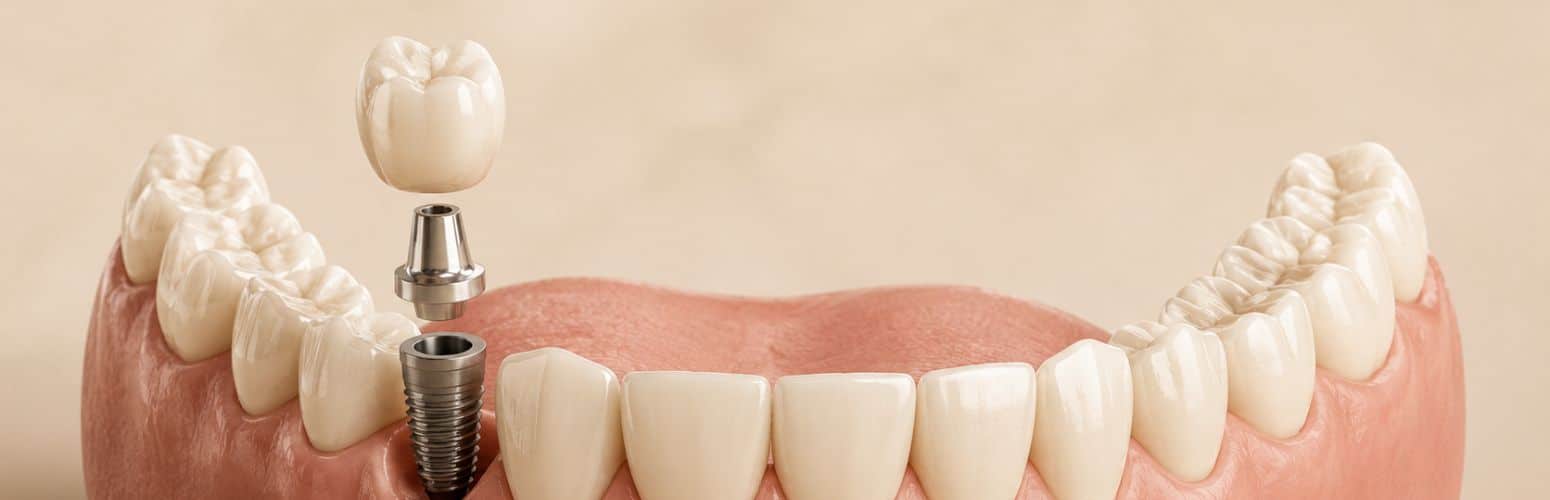
A completed implant tooth has three distinct components. Understanding them is essential before comparing prices.
The Fixture
The titanium post placed surgically into the jawbone. This is the artificial root — the component that integrates with bone and the only part covered by the MediSave surgical claim under TOSP SB816M.
The Abutment
A small connector seated onto the implant once osseointegration is confirmed. It links the buried fixture to the visible crown above the gumline. Not MediSave-claimable.
The Crown
The visible, tooth-shaped ceramic restoration seated on the abutment. At Dentalis, crowns are ceramic and matched to the colour and form of surrounding teeth. Not MediSave-claimable under the standard surgical TOSP code.
What this means when comparing prices: A headline fee for “an implant” may cover only the fixture. The all-inclusive fee at Dentalis — fixture, abutment, and ceramic crown — starts from S$4,500 before 9% GST. Consultation (S$80) and CBCT scan (S$150) are charged separately.
Are You Suitable?
Who Is a Good Candidate?
Most adults missing one or more teeth are potential candidates. Suitability is medical and anatomical — not a matter of age alone. Patients in their sixties, seventies and beyond receive implants at Dentalis following a standard clinical review.
Can the natural tooth still be saved?
The first question is not whether to place an implant. It is whether the existing tooth can still be preserved. Depending on the diagnosis, alternatives to extraction include root canal treatment, a crown or restorative work, gum treatment, or monitoring. A maintainable natural tooth is generally worth preserving. An implant should not be presented as a shortcut around proper diagnosis.
“I rarely recommend an implant as the first conversation. The first conversation is always about what can still be saved. If a tooth can be maintained predictably — with a root canal, a crown, proper gum treatment — that is where we start. An implant is a good solution. A natural tooth that functions well is a better one. We only move toward replacement when preservation no longer makes clinical sense.”
— Dr Jonathan Liu, BDS NUS · SDC D21395J · Founder, Dentalis
What your dentist will assess
- Bone volume and density at the proposed site
- Gum health — active gum disease must be treated before placement
- General health and medications (including bisphosphonates and anticoagulants, which may affect healing)
- Medical conditions — diabetes and osteoporosis require assessment but do not automatically disqualify you
- Smoking — significantly reduces healing blood supply and long-term outcomes
- Bruxism — habitual teeth grinding places sustained force on the implant; a night guard may be recommended
- Age — treatment is generally deferred until jaw development is complete (18+); there is no upper age limit
What if you do not have enough bone?
Bone volume reduces after tooth loss. Where the site lacks adequate height or width, bone grafting or a sinus lift may restore the foundation required. The need cannot be determined from appearance alone — CBCT imaging is required.
Precision Before Surgery
Why Imaging Comes First
A CBCT scan produces a three-dimensional model of your jaw — unlike a conventional 2D X-ray, which cannot reliably show bone depth, nerve canal position, or sinus proximity. At Dentalis, every implant case begins with a CBCT assessment before any treatment is recommended.
The Orthophos S CBCT at Dentalis allows Dr Liu and Dr Albert Lee to assess: the exact bone height, width, and density at the proposed site; the position of the inferior alveolar nerve in the lower jaw; the distance from the proposed site to the sinus floor in the upper jaw; and whether bone grafting or a sinus lift will be required. Digital crown planning is supported by the iTero Lumina Pro intraoral scanner.
The CBCT scan is S$150 before 9% GST, charged separately at the time of assessment.
What to Expect
The Implant Treatment Process
A straightforward single-tooth case typically takes three to nine months from consultation to the final crown, depending on whether preparatory procedures are required.
Stage 1 — Assessment and planning
The consultation involves a full clinical examination, medical history review, dental X-rays, and a CBCT scan. Dr Liu will review findings with you, outline the treatment sequence and timeline, and provide a written cost estimate before any procedure begins.
Stage 2 — Tooth extraction, where required
If the tooth is still present, it must be removed before or at the time of implant placement. In selected cases — where there is no active infection and bone volume is adequate — the implant can be placed on the same day as extraction. This is not suitable for every patient and is assessed case by case.
Stage 3 — Bone grafting or sinus lift, where required
Where the CBCT scan shows insufficient bone volume, a bone graft may be required before or during implant placement. For upper back-tooth sites where the sinus limits available bone height, a sinus lift may be needed. Both can sometimes be performed simultaneously with implant placement. A separate procedure requires a healing period of four to six months before implant placement can proceed.
Stage 4 — Implant placement
The treatment area is anaesthetised using Calaject® — a computer-controlled local anaesthesia delivery system that regulates injection pressure, making the procedure more comfortable than conventional syringe delivery. You will feel pressure during placement, not pain. IV sedation is available for anxious patients (S$1,200 per hour + S$600 per subsequent 30 minutes).
Stage 5 — Osseointegration
The bone grows into and around the titanium surface over the weeks and months that follow. This biological process is called osseointegration. It is not something you will feel. A temporary restoration may be provided during this period. Osseointegration typically takes three to six months; exact timing depends on bone quality, implant location, smoking history, and general health.
Stage 6 — Abutment and final crown
Once osseointegration is confirmed, the abutment is attached and a digital scan is taken using the iTero Lumina Pro intraoral scanner to fabricate the final ceramic crown. The crown is matched to the colour and shape of your surrounding teeth. A bite check and follow-up review complete the process.
Understanding the Price
How Much Does a Dental Implant Cost in Singapore?
Implant prices in Singapore range from under S$2,000 to over S$6,000 for a completed single tooth. The variation is real — and it reflects genuine differences in implant brand, crown material, included services, and clinical standards.
Dentalis fee
A complete single implant at Dentalis starts from S$4,500 before 9% GST. This includes the implant fixture, abutment, and ceramic crown. Local anaesthesia is included.
| Item | Fee before GST |
|---|---|
| Single implant (fixture + abutment + ceramic crown) | From S$4,500 |
| Consultation | S$80 |
| CBCT scan | S$150 |
| IV sedation | S$1,200 / hour |
| IV sedation — subsequent time | S$600 per 30 min |
| Bone graft | From S$800 |
| Sinus lift | From S$1,000 |
Fees are indicative estimates before 9% GST. An actual quote will be provided following your consultation and CBCT assessment.
What determines the price
At Dentalis, the Camlog implant system — engineered by the BioHorizons Camlog Group — is used for all implant cases. A published peer-reviewed study (Nentwig, 2004) reported a five-year implant survival rate of 97.6% with stable peri-implant bone levels.
The point most patients do not hear often enough: clinical literature consistently shows that implant outcomes depend more heavily on surgical precision and patient selection than on the brand itself. The system your dentist has trained with extensively and plans each case around carefully tends to produce better results than a premium brand placed by an unfamiliar hand. The choice of implant system at Dentalis was deliberate: European-engineered, with a published clinical record and the component availability that long-term implant care requires. Price was not the deciding factor in either direction.
Crown material names — “zirconia”, “ceramic”, “PFM” — do not indicate uniform quality. The grade, thickness, and fabrication method affect both aesthetics and longevity.
Front tooth vs back tooth — does position affect cost?
Yes, in most cases. A front tooth (anterior) implant involves additional aesthetic demands that a back tooth (posterior) implant does not. These include a more precise shade match for the ceramic crown, a temporary crown to maintain appearance during osseointegration, more detailed shaping of the emergence profile to mirror the surrounding gum architecture, and in some cases a custom abutment rather than a standard one. These add to both the laboratory cost and the clinical time involved.
A back tooth implant — replacing a molar or premolar — is primarily functional. The crown is less visible and shade matching is less critical, but the implant bears greater bite force, which influences the choice of fixture diameter and crown material. Where back teeth have been missing for some time, bone resorption is often more significant and bone grafting more frequently required.
The fee quoted at consultation will reflect the position of the tooth being replaced. Front and back tooth implants at Dentalis use the same Camlog fixture system; the variation lies in the crown specification and clinical steps involved. Confirm the complete scope at your consultation before accepting any quote.
Why do prices vary so much between clinics?
The most important variable is the experience and qualifications of the surgeon performing the procedure. Beyond that: the implant system and its origin (Korean, South American, European); whether the crown is a standard PFM or full ceramic; whether CBCT imaging is included; and whether bone grafting or sinus lifting is anticipated or excluded from the quoted fee. Always request an itemised quote before comparing.
Tanjong Pagar · Singapore CBD
Start with the assessment. Not assumptions.
Consultation S$80 · CBCT Scan S$150 · Before 9% GST
No waitlist. Dr Jonathan Liu and Dr Albert Lee, 40+ years combined clinical experience.
CPF MediSave Claims
Using MediSave for a Dental Implant
Singapore Citizens and Permanent Residents can use CPF MediSave to offset the cost of the surgical component of dental implant treatment, subject to eligibility and CPF Board approval. The claimable amount under TOSP SB816M is S$1,120 per implant plus S$830 surgical consumables per session — regardless of how many implants are placed in that session. For a single-implant session, the total claim is S$1,950. MediSave does not cover crowns, abutments, consultations, or CBCT scans.
What is claimable — confirmed TOSP codes (effective 4 January 2025)
| TOSP Code | Procedure | Total withdrawal limit |
|---|---|---|
| SB816M | Insertion of endosseous dental implant | S$1,120 per implant + S$830 surgical consumables per session = S$1,950 total (1 implant) |
| SB803M | Alveoloplasty or bone regenerative procedure (simple) | S$1,120 + up to S$830 surgical consumables per session = Up to S$1,950 total (1 implant) |
| SB802M | Augmentation of maxillary sinus floor — unilateral, lateral window approach | S$1,390 + up to S$830 surgical consumables per session = Up to S$2,220 |
| SB814M | Augmentation of maxillary sinus floor (bilateral) or multi-quadrant bone augmentation | Up to S$3,210 |
The same-day rule — what many clinics do not explain
If bone grafting (SB803M) or a sinus lift (SB802M/SB814M) is performed on the same day as implant placement (SB816M), only one TOSP code applies — the one representing the higher-value procedure. The two limits are not added together. This is a common source of confusion when comparing MediSave amounts across clinics.
What is not claimable
The crown, abutment, consultation, CBCT scan, and non-surgical components of treatment are not covered by the surgical TOSP codes above.
Using a family member’s MediSave
Under CPF rules, you may use the MediSave of an immediate family member — spouse, children, parents, grandparents, or siblings — subject to their available balance and CPF eligibility. Dentalis handles MediSave paperwork at the clinic.
Why some clinics advertise no cash top-up
You may have seen advertisements for dental implants with “no cash top-up required” or total fees of S$1,250 to S$1,950 — covered entirely by MediSave. This is sometimes achievable by selecting an implant system and crown priced to fall within the claim limit.
The analogy is useful: a Korean car and a German car are both cars. The journey is the same. The engineering, materials, and long-term ownership experience are not. Implant systems vary by origin, material grade, clinical track record, and component longevity. A MediSave-covered package and an all-inclusive quoted fee are not the same thing. Before comparing, ask: which implant brand, what crown material, is CBCT imaging included, and who performs the surgery.
MediSave eligibility and claimable amounts are subject to CPF Board approval and the procedures performed. Confirm your specific claim with Dentalis during your consultation.
View the full MediSave TOSP table and same-day claim rules →
Subsidies & Insurance
CHAS and Dental Insurance
CHAS
CHAS does not subsidise the implant surgical procedure itself. CHAS subsidies apply at Dentalis to the following implant-adjacent services for eligible cardholders:
| Service | Pioneer | Merdeka | CHAS Blue | CHAS Orange |
|---|---|---|---|---|
| Consultation | S$30.50 | S$25.50 | S$20.50 | S$13.50 |
| X-ray | S$21.00 | S$16.00 | S$11.00 | S$7.50 |
Dental insurance
A number of international and corporate health insurers include dental implant coverage or implant co-payment within their higher-tier policies. Insurers whose plans may include implant coverage, depending on policy terms, include Cigna International, AXA PPP International, Allianz Care, Bupa International, Groupe Henner, and Alliance MediNet. Coverage varies significantly by policy tier, waiting period, and annual limit.
Dentalis issues fully itemised receipts for patient self-claim where direct billing is not in place. If you hold corporate or international dental insurance, bring your policy schedule to your consultation.
Knowing Your Options
Dental Implant vs Bridge vs Denture
An implant is not always the right answer. The best option depends on the number of missing teeth, the condition of adjacent teeth, available bone, budget, and long-term maintenance preferences.
| Implant | Bridge | Denture | |
|---|---|---|---|
| Replaces tooth root | Yes | No | No |
| Preserves jawbone | Yes | No | No |
| Adjacent teeth affected | Usually no | Yes — require preparation | No |
| Removable | No | No | Yes |
| MediSave claimable | Yes — surgical component (SB816M) | No | No |
| Approx. cost (Singapore) | S$1,250–S$6,000+ | S$800–S$4,000 | S$350–S$4,000+ |
| Longevity | Fixture: decades. Crown: 15–25 years | 10–15 years | 5–10 years |
A bridge may be appropriate when neighbouring teeth already require crowns, or when implant surgery is not suitable. The longer a gap is left unfilled, the greater the bone loss at the site — which can make future implant placement more complex.
Dental Implants vs Dentures → Dental Implant vs Bridge → Root Canal vs Implant →
Long-Term Performance
Longevity, Risks, and Maintenance
The titanium fixture, once fully integrated, can remain functional for decades. The ceramic crown typically requires replacement after 15 to 25 years due to normal wear — a single-appointment procedure that does not disturb the implant below.
Peri-implantitis — the primary long-term risk
An implant cannot develop tooth decay. However, the surrounding gum and bone can be affected by plaque-related disease — a condition called peri-implantitis. This is the most common cause of long-term implant failure and is broadly analogous to gum disease around a natural tooth. It is preventable with good daily cleaning, regular professional maintenance, and six-monthly implant reviews.
Can a dental implant fail?
Failure is uncommon but possible. Early failure — during osseointegration — typically involves infection, excessive load during healing, or factors such as smoking or poorly controlled diabetes affecting bone integration. Late failure is most commonly caused by peri-implantitis. Structured follow-up, professional cleaning, and good daily hygiene are the most effective preventive measures. If an implant fails, it may need to be removed; reassessment and a replacement implant or alternative restoration may be considered depending on remaining bone and gum condition.
What are the surgical risks?
Dental implants involve surgery and carry associated risks. Short-term possibilities include infection, swelling, and bleeding. Rare but possible complications include injury to the inferior alveolar nerve causing altered sensation, sinus complications for upper back-tooth placements, and failure of the implant to integrate. Risk is reduced through CBCT planning and appropriate patient selection, but cannot be eliminated entirely.
Maintenance
- Brush twice daily; use an interdental brush around the implant
- Six-monthly professional review and cleaning
- Annual bone-level monitoring via X-ray
- Night guard recommended for patients who grind (bruxism)
- Smoking cessation advised — significantly reduces long-term success rates
Who Performs Your Implant
Implant Treatment at Dentalis
Principal Dentist · Dental Implants
Dr Jonathan Liu
BDS NUS · SDC D21395J · 25+ years · 10,000+ patients
Dr Jonathan Liu has over 25 years of clinical experience and has treated more than 10,000 patients. He brings a considered, unhurried approach to each case.
Read Dr Liu’s profile →Oral & Maxillofacial Surgeon · Specialist Surgical Cases

Dr Albert Lee Ming Hsien
BDS NUS · MDS OMS · F.A.M.S. · SDC D22238J · 15 years
Dr Albert Lee is an MOH-accredited Dental Specialist in Oral and Maxillofacial Surgery with over 15 years of experience. Dr Lee performs the specialist surgical component for appropriate implant cases, including those requiring bone grafting or ridge preservation.
Read Dr Lee’s profile →40+ years combined clinical experience between Dr Liu and Dr Albert Lee. Before agreeing to treatment at any clinic, confirm the registration number of the surgeon on the Singapore Dental Council register at sdc.edu.sg. For complex cases involving bone grafting or sinus lifting, ask whether the treating dentist holds specialist accreditation in Oral and Maxillofacial Surgery.
A Considered Approach
“An implant placed without adequate imaging is an implant placed on assumptions. At Dentalis, every case begins with a CBCT scan — we map the bone density, the nerve position, and the sinus proximity. The implant itself is straightforward. The planning is where the outcome is determined.”
Common Questions
Dental Implants in Singapore — Frequently Asked Questions
Implant prices in Singapore range from approximately S$1,250 to S$6,000+ for a completed single tooth, before 9% GST. The variation reflects genuine differences in implant brand, crown material, and what is included. At Dentalis, a complete single implant starts from S$4,500 before GST — this includes the fixture, abutment, and ceramic crown. Consultation (S$80) and CBCT scan (S$150) are charged separately. When comparing prices, always confirm whether the quoted fee includes the crown and abutment, as many advertised prices cover only the fixture and surgery.
For a single endosseous implant under TOSP code SB816M (effective 4 January 2025), the MediSave claim comprises S$1,120 per implant for the surgical fixture placement, plus S$830 surgical consumables per session — a total of S$1,950 for a single-implant session. The consumables allowance is per session, not per implant: placing three implants in one session gives S$(1,120 × 3) + S$830 = S$4,190. The crown, abutment, consultation, and CBCT scan are not claimable under this code. For bone grafting performed separately, SB803M allows up to S$1,950. For a qualifying unilateral sinus lift, SB802M allows up to S$2,220. You may also use the MediSave of an immediate family member, subject to CPF eligibility. Dentalis processes MediSave claims at the clinic.
Some clinics price their implant packages — including the implant brand, crown material, and included services — at a total fee that falls within the MediSave claim limit of S$1,950. This makes a “no cash top-up” claim possible. A Korean or South American implant system with a standard crown can be packaged to meet that threshold. A German-engineered implant system with a ceramic crown, CBCT imaging, and specialist surgical oversight is a different clinical package. Both are implants. The materials, clinical track record, and standard of planning are not the same. Before comparing prices, ask what implant brand will be used, what crown material is included, whether CBCT imaging is part of the package, and who performs the surgery — their qualifications, specialist accreditation, and years of clinical experience.
Bone loss at a missing-tooth site is common — it begins within weeks of extraction. Whether you remain suitable for an implant depends on how much bone remains. A CBCT scan gives a precise three-dimensional measurement of available bone height and width. Where bone volume is insufficient, a bone graft or sinus lift may restore the foundation required for placement. Many patients who assume bone loss has disqualified them are still candidates following assessment.
The treatment area is anaesthetised before any procedure begins. At Dentalis, local anaesthesia is delivered using Calaject® — a computer-controlled system that regulates injection pressure, which most patients find significantly more comfortable than conventional syringe delivery. During the procedure itself, you will feel pressure and vibration but not pain. Tenderness and mild swelling in the days following surgery are normal and are managed with prescribed medication. IV sedation is available for patients who prefer it.
Failure is uncommon but possible. Early failure during osseointegration typically involves infection, excessive load on the implant during healing, or factors such as smoking or poorly controlled diabetes. Late failure is most commonly caused by peri-implantitis — an inflammatory condition affecting the bone around the implant, driven by plaque accumulation. Surgical risks include rare complications such as nerve sensitivity, sinus involvement for upper back-tooth placements, and failure to integrate (affecting fewer than 5% of cases in clinical literature). Risk is reduced through CBCT planning and appropriate patient selection. Regular follow-up and good oral hygiene are the most effective preventive measures.
The titanium fixture, once integrated, can remain functional for decades with appropriate care. The ceramic crown typically lasts 15 to 25 years before wear may require replacement — a single-appointment procedure that does not disturb the implant below. The most significant threats to longevity are peri-implantitis, smoking, bruxism without a protective night guard, and gaps in professional maintenance. Patients who attend six-monthly reviews and maintain good daily hygiene have the best long-term outcomes.
Treat the implant like a natural tooth, with a few additions. Brush twice daily and use an interdental brush to clean around the implant post. Floss daily. Attend professional cleaning and clinical review every six months — your dentist will check gum inflammation, bone levels, crown stability, and bite alignment. Annual X-rays are recommended to monitor the bone around the implant. If you grind your teeth at night, a custom night guard protects both the crown and the implant from excessive bite force. Report any looseness, persistent tenderness, or gum changes to your dentist promptly.
A dental bridge or removable denture will cost less upfront. A bridge — which uses adjacent teeth as anchors for a fixed false tooth — typically costs S$800–S$4,000. A denture starts from around S$1,500. Neither replaces the tooth root or preserves the jawbone. Over a 15–20 year period, when replacement and repair costs are factored in, an implant often works out comparable in total cost to a bridge and less expensive than multiple rounds of denture replacement. The right choice depends on clinical factors, adjacent tooth condition, budget, and personal preference.
All-on-4 refers to a complete arch of replacement teeth — typically 10 to 14 teeth — supported by four strategically positioned implants. It is designed for patients who have lost, or expect to lose, most or all teeth in one jaw. It is not a treatment for replacing individual missing teeth. The correct number of implants and the design of the final restoration must be determined through individual assessment and 3D imaging. All-on-4 requires a separate consultation and treatment plan from single-tooth implant treatment.
In most cases, yes. A front tooth implant (anterior) involves additional aesthetic steps not required for a back tooth: a closer shade match for the ceramic crown, a temporary crown during osseointegration to maintain appearance, and more precise shaping of the emergence profile through the gum. These add laboratory and clinical time. A back tooth (posterior) implant is primarily functional — the crown is less visible and shade matching is simpler, though the implant must bear heavier bite forces. The fee for the implant fixture itself is the same regardless of position; the difference lies in the crown specification and clinical steps. Your consultation will confirm the full scope and cost for your specific case.
Tanjong Pagar · Singapore CBD
Considering a dental implant? Start with the right imaging.
A CBCT scan and consultation at Dentalis gives you a precise picture of bone volume, nerve position, and implant site anatomy before any treatment is discussed.
Consultation S$80 · CBCT Scan S$150 · Before 9% GST
About This Page
Reviewed by Dr Jonathan Liu, BDS National University of Singapore, SDC Registration D21395J
25+ years clinical experience · 10,000+ patients · Founder, Dentalis
This page provides general patient education about dental implants in Singapore. It does not constitute medical advice. MediSave figures are based on the TOSP schedule effective 4 January 2025. Fees are indicative before 9% GST. An actual quote and treatment recommendation require individual clinical assessment. Last reviewed: June 2026.