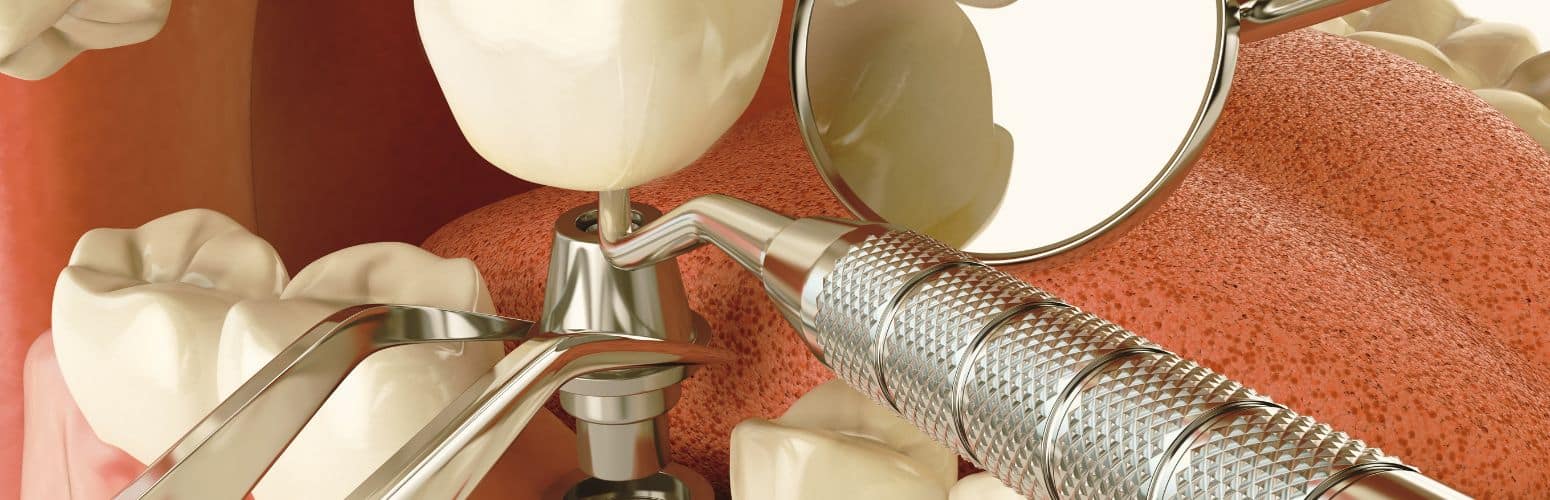
Tooth extraction — if the tooth is still present
If the tooth being replaced has not yet been extracted, this typically occurs in a separate appointment before implant planning, or at the time of placement in selected cases (immediate implantation). Where immediate placement is being considered — placing the implant at the same appointment as the extraction — the site must have no active infection, adequate bone, and the fixture must achieve sufficient primary stability. This is assessed individually at consultation and is not suitable for all cases. The osseointegration period is the same regardless of timing.
Anaesthesia — Calaject®
Local anaesthesia is administered using Calaject® — a computer-controlled delivery system that regulates the flow rate of the anaesthetic solution precisely. Unlike a standard syringe, which delivers a rapid bolus, Calaject controls pressure at the injection site. This eliminates the sharp stinging sensation associated with rapid injection. Most patients at Dentalis describe the numbing process as unremarkable.
IV sedation (S$1,200/hr, then S$300/15 min) is available for patients who prefer to be in a lightly sedated state throughout. It is not required for most single-implant placements.
Guided keyhole surgery — how the surgical guide works
Before any incision is made, the CBCT scan data is used to plan the implant’s position in three dimensions — exact depth, angle, and proximity to the nerve canal. At Dentalis, this plan is converted into a surgical guide: a precision-fitted template that physically constrains the drill path during placement, so that what is planned on screen is precisely what is executed in the jaw.
Why the guide matters — the wall-drilling analogy
Drilling a hole in a wall without a guide relies entirely on the operator’s eye. A small deviation in angle at the surface becomes a significant deviation by the time the drill reaches depth — potentially hitting a pipe or stud. The same principle applies in implant surgery. Without a guide, even an experienced surgeon estimates depth, angle, and nerve clearance visually. A surgical guide removes that variable: the drill can only travel along the planned path, to the planned depth, at the planned angle. The outcome of the implant placement is determined before the surgery begins, not during it.
A systematic review of 1,495 implants placed using guided surgery (Dioguardi et al., J Clin Med 2023) reported implant survival rates of 96.3–100% across nine prospective and retrospective studies, with a mean positional accuracy of 0.5 mm vertically and 1.2 mm horizontally.2 A separate RCT review (Colombo et al., BMC Oral Health 2017) found statistically significantly less post-operative pain and swelling in the guided group compared to free-hand placement — attributed primarily to the flapless technique enabled by precise pre-planning.3 A 2026 case report confirmed that a tooth-supported static guide achieved postoperative deviations of ≤2° in angulation and ≤1 mm positionally, consistent with the published accuracy range for this technique.4
The guided surgery approach is bundled into the Dentalis surgical fee — it is not a separate charge. The from S$4,500 Camlog all-inclusive fee covers the fixture, abutment, ceramic crown, local anaesthesia, and surgical guide preparation. The guide is one reason the fee remains flexible rather than fixed: the complexity of the surgical template depends on the individual case, and this is confirmed at consultation.
What guided surgery reduces
✓Risk of implant malposition affecting crown emergence
✓Risk of nerve proximity in lower jaw cases
✓Post-operative swelling and discomfort (flapless approach)
✓Surgical time through a pre-confirmed trajectory
What a surgical guide does not replace
—Clinical experience and judgment at the chair
—Accurate CBCT planning upstream — garbage in, garbage out
—Patient compliance during osseointegration and maintenance
The placement
Once fully numb, an incision is made in the gum and a precisely dimensioned channel is drilled in the jawbone — following the position and angulation mapped from the CBCT plan. The Camlog implant fixture is placed into the channel. The gum is closed with sutures around or over the fixture, depending on the case design.
A temporary crown is provided for visible front-tooth sites during healing. For back teeth, a temporary partial denture or nothing is appropriate, depending on the position and patient preference.
A straightforward single-implant placement takes approximately sixty to ninety minutes.
Post-operative on the day
What is normal
●Mild swelling and tenderness at the site
●Minor bleeding, settling within a few hours
●Soreness peaking Day 2–3, then subsiding
●Soft diet for the first 24–48 hours
Contact Dentalis immediately if you experience
—Pain increasing after Day 3
—Worsening swelling or spreading redness
—Pus, discharge, or foul taste
—Any movement or looseness of the implant
Most patients return to desk work within 24–48 hours of a straightforward placement. Written aftercare instructions and pain relief are provided at discharge.