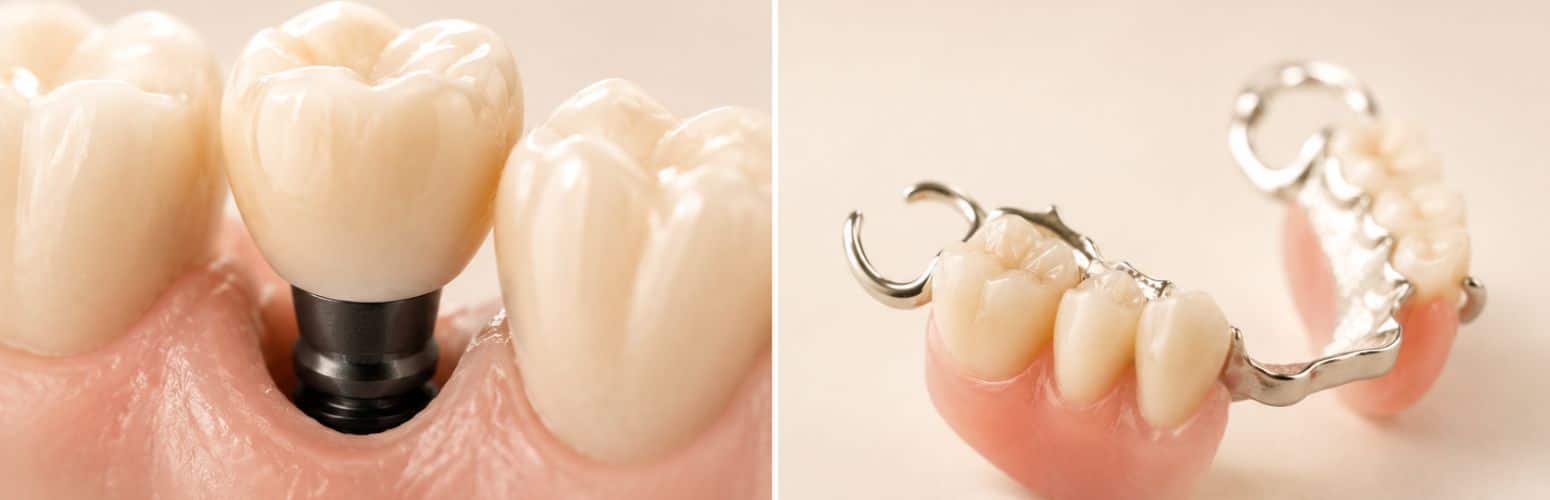
1. Function, chewing, and stability
Dental implants generally provide greater bite stability and a closer functional parallel to natural teeth; dentures provide a faster, non-surgical, and lower-cost way to replace several or all missing teeth.
A dental implant is fixed in the jawbone and functions similarly to a natural tooth — most patients eat, speak, and go about daily life without restriction from the restoration itself. There is nothing to remove, no adhesive required, and no concern about movement during eating for the vast majority of patients. Individual outcomes depend on bone quality, placement technique, and maintenance.
A denture rests on the gums and relies on suction, adhesives, or clasps for retention. Upper dentures, supported by the palate, typically provide more stability than lower dentures. Lower conventional full dentures provide less bite stability due to the smaller surface area of the lower ridge — something many patients manage well with adjustment and proper fitting. Partial dentures, which clasp to remaining natural teeth, perform better than full lower dentures but may place some stress on anchor teeth over time.
Modern dentures, when well-fitted and maintained, allow most patients to eat a normal diet and speak clearly. For patients replacing an entire arch, a well-made denture restores significant function — particularly for upper arch cases where palatal coverage improves stability.
For a full explanation of denture types and how they are fitted at Dentalis, see the dentures guide →
2. Jawbone health — the long-term structural difference
When a tooth is lost, the bone that once surrounded its root begins to resorb. This is a well-documented biological process — bone requires functional stimulation from a root to maintain its density and volume. Without it, the jaw changes shape over time.
A dental implant replaces the root and provides functional loading to the bone through normal bite forces. Clinical evidence generally supports better bone maintenance at implant sites compared with unrestored extraction sites over the medium and long term,1,2 though outcomes vary by patient health, implant placement, and maintenance. Bone levels around implants are monitored at annual professional reviews.
A denture does not provide root-level stimulation. Alveolar resorption continues at denture sites, which over years causes the jaw to change shape and denture fit to deteriorate. This is a structural consequence of the absence of a root — not a design flaw in the denture itself. The clinical result is that dentures typically require relining or replacement every five to ten years as the jaw changes beneath them.
For patients receiving a full arch denture, two to four strategically placed implants per arch (implant-supported dentures) can interrupt bone loss at those sites while still using a removable prosthesis — a middle path between full implant reconstruction and conventional dentures.
3. Appearance, speech, and facial support
Both dental implants and modern dentures can produce natural-looking, aesthetically pleasing results. The difference tends to emerge over time.
A dental implant crown maintains its position and the surrounding gum architecture when bone beneath it is preserved. Implant restorations are designed for long-term function, though the crown, surrounding soft tissue, and bone still require ongoing maintenance and professional review. Individual longevity depends on oral hygiene, bite forces, and health factors.
A denture can look and function well initially. As the jawbone changes shape beneath it, the fit changes and adjustments are needed. Long-term alveolar resorption beneath full dentures can alter the lower facial profile as bone volume decreases. Well-made implant-supported dentures significantly reduce this effect at implant sites.
Speech with a denture typically requires a short adjustment period — most patients adapt within a few weeks. Implants generally do not affect speech once the crown is fitted, though this can vary depending on crown shape and position.
When bone loss has already occurred
Significant bone loss prior to treatment does not necessarily rule out an implant, but it may require additional steps. Where bone volume is insufficient, a bone graft (from S$800) or sinus lift procedure is assessed before implant placement. A CBCT scan (S$150 at Dentalis) provides the 3D bone map needed to determine suitability. For patients with advanced bone loss, implant-supported dentures using shorter or wider implants may be an option — this is assessed case by case at consultation.
4. Maintenance and daily care
An implant is maintained like a natural tooth: brush, use an interdental brush or floss around the implant margin, and attend professional cleaning. No removal is required. Professional cleaning at Dentalis uses the EMS AIRFLOW® Guided Biofilm Therapy protocol, which removes biofilm from implant surfaces without the micro-scratching that metal scalers can cause on titanium.
A denture requires daily removal for cleaning, soaking overnight in denture solution, and careful handling to avoid damage. The routine is straightforward once established. Many patients find it manageable; others find the daily removal inconvenient, particularly when staying away from home or travelling.
Both options require regular professional review — to check bone levels around implants, and to assess denture fit and gum health beneath dentures.
Modern dentures are a reliable, well-established tooth replacement solution. For patients replacing an entire arch, or for those for whom implant surgery is not suitable, they remain clinically appropriate and widely used. The choice between the two options should be guided by individual clinical circumstances — not by a general preference for one over the other.