
The Informed Patient
Best Dentist in Singapore:
How to Choose the Right Clinic
The best dentist in Singapore diagnoses accurately, explains your options clearly, and treats conservatively. Not the most advertised, the cheapest, or the highest-ranked on a paid directory.
This guide gives you the exact framework, verified cost data, MediSave/CHAS rules, and red flags to find the right dental clinic for your specific situation.
At a Glance
Before you choose a dentist in Singapore — what you need to know
- All practising dental professionals must be registered with the Singapore Dental Council (SDC) — publicly searchable at sdc.gov.sg
- MediSave covers surgical dental procedures (wisdom tooth surgery, implants) — not scaling, fillings, or root canal
- CHAS subsidises basic dental care at enrolled clinics for qualifying Singaporeans — check chas.sg for enrolled clinic list
- Most "best dentist" lists online are directory aggregators or paid Google Ads — not clinical assessments
- A trustworthy clinic gives you a written treatment plan with itemised costs before any procedure begins
- Singapore has over 1,000 registered dental clinics — "best" is always relative to your treatment need, location, and priorities
- As of end-2024, Singapore had 2,812 registered dentists serving a population of approximately 6 million — a dentist-to-population ratio of 1:2,147. Source: MOH Health Manpower Statistics
What makes a dentist good — and how do you verify it?
Singapore has 2,812 registered dentists serving over 6 million people. Most are qualified. What separates a good dentist from the right dentist for you is not the certificate on the wall — it is how they communicate, how they make you feel, and whether they treat you as a person rather than a procedure.
A dentist who ranks #1 on Google has invested in SEO or paid advertising. That tells you nothing about their clinical judgement, chairside manner, or how they handle a patient who is nervous, in pain, or uncertain about a major decision.
Here is how patients actually find a dentist they trust — and how to verify the basics before you commit.
1. Word-of-mouth referrals — the most reliable signal
A personal recommendation from someone who has sat in the same chair and come back willingly tells you what no advertisement can: how the dentist speaks, listens, explains, and makes a patient feel. Ask the people you trust:
- Who is your dentist, and would you go back without hesitation?
- Do they explain what they're doing and why?
- Do you feel rushed — or genuinely cared for?
- Have you referred a family member to them?
Words like "gentle", "explains everything", "never felt pressured", and "I actually don't dread going anymore" are the strongest signals in any referral. They describe the experience, not just the outcome.
Paid search results reflect marketing budgets. A 10-year recommendation from a colleague reflects something that cannot be bought.
2. How the clinic handles comfort and dental anxiety
For many patients, choosing a dentist is not primarily a clinical decision — it is an emotional one. An estimated 15–40% of adults carry some degree of dental anxiety, often rooted in a prior painful or rushed experience.
A clinic that takes this seriously will show it in how it is designed, not just what it claims. Look for:
- Longer appointment slots — not 15-minute turnarounds
- A dentist who explains each step before performing it
- Topical anaesthetic applied before any injection
- Computer-assisted anaesthesia systems (e.g. Calaject) that eliminate injection pressure
- An environment that is calm rather than clinical — lighting, acoustics, design
- Staff who acknowledge anxiety rather than dismiss it
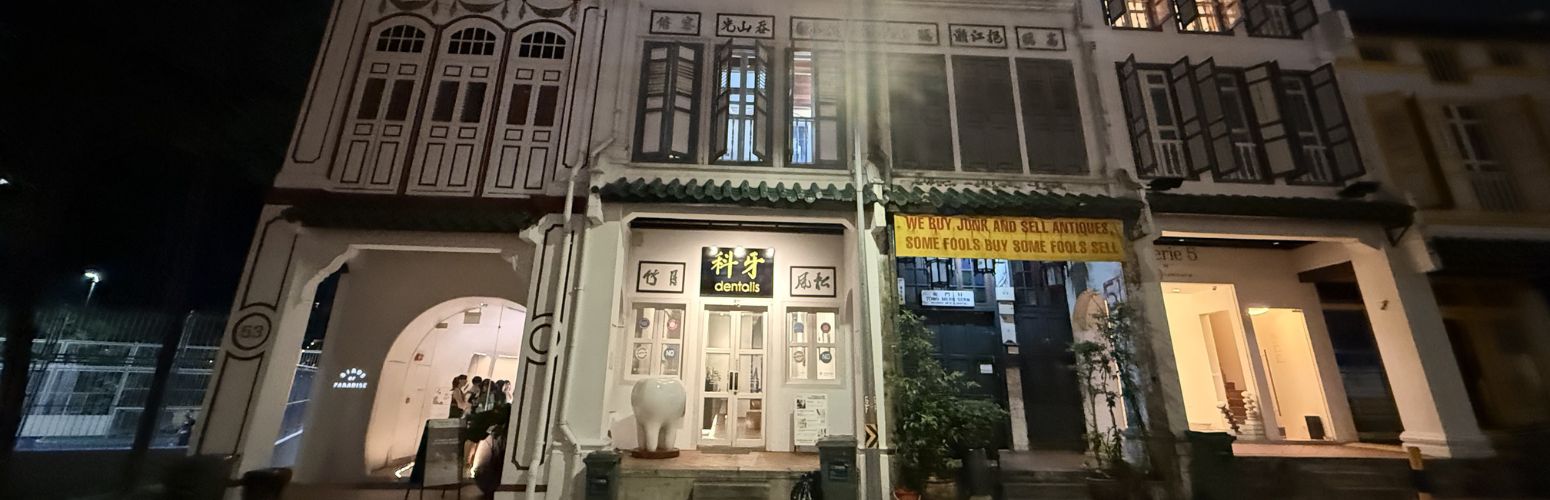
Dentalis was conceived as an urban sanctuary for calm, thoughtful care — located in a heritage shophouse in Tanjong Pagar. Every element of the environment is designed for patients who have had poor experiences elsewhere, or who simply want dental care that feels unhurried and human.
3. Your personal experience and preference
There is no objective Dentalis"best dentist in Singapore." There is the right dentist for you, for your treatment, at this stage of your life.
After your first consultation, ask yourself honestly:
- Did I feel genuinely listened to — or processed?
- Was I shown my X-rays and talked through the findings?
- Did I leave with clarity, or with more anxiety than I arrived with?
- Would I be comfortable returning for a long-term treatment?
- Does the dentist's communication style work for me?
Trust your response to the first consultation. It is usually the clearest signal you will get. A clinic that invests time in your first visit is showing you how every future visit will feel.
4. SDC registration — the non-negotiable baseline
Every dentist practising in Singapore must hold a valid registration with the Singapore Dental Council (SDC) and a current practising certificate. Both are legally required under the Dental Registration Act.
Between 2023 and 2025, more than 20 doctors and dentists in Singapore were investigated for practising without valid registration or with expired practising certificates — cases reported by the Ministry of Health. In a separate 2024 case, a self-taught Malaysian woman was fined for performing illegal dental procedures, including veneer application, on patients in Singapore hotel rooms, having never been registered under the Dental Registration Act. A dentist practising without a valid current practising certificate can be fined up to $25,000 for a first offence.
Separately, dental advertising in Singapore is governed by the Healthcare Services Act and MOH Publicity Guidelines. Any clinic claiming to be "the best", “top dentist”, “highly recommended dentist” or "number one" without verifiable evidence is in breach of these guidelines.
How to verify any dentist in Singapore — 3 steps:
- Go to sdc.gov.sg
- Click "Register of Dentists" in the navigation
- Search by the dentist's full name. Confirm: registration number, qualifications, specialist status, and that the registration is current.
Dr Jonathan Liu at Dentalis: SDC Registration D21395J — verifiable directly at sdc.gov.sg.
5. Years of experience and real case volume
Qualifications establish the baseline. Experience shapes clinical judgement. A dentist with 20+ years and high case volume has encountered the unusual, the complex, and the ambiguous. Ask specifically: how many cases of your treatment have they completed in the last two years?
6. Continuity of care — the same dentist, every visit
Public institutions (Polyclinic, NDCS) and dental chains rotate associate dentists between locations. Your second appointment may be with a different clinician who has not read your notes, does not know your anxiety triggers, and is starting from scratch on your history. For multi-visit treatments — Invisalign, dental implants, full-mouth rehabilitation — this is a structural problem, not an inconvenience. At a smaller clinic, the same dentist is usually present at every appointment.
7. Long-term thinking over episodic fixes
The best dental professionals do not treat in episodes. They plan around long-term facial harmony, healthy gum architecture, bite stability, and preservation of natural tooth structure. At Dentalis, this is formalised as the Longevity Framework — where every clinical decision is evaluated for its impact ten or twenty years forward, not just today.
8. Conservative philosophy: what they don't recommend matters as much as what they do
An honest dentist will tell you what does not need treating. They present alternatives. They do not recommend procedures at speed. Ask at your consultation: "What would happen if we monitored this rather than treated it?" A patient-first practice will take time for that conversation.
How much does dental treatment cost in Singapore in 2026?
Private dental clinic fees in Singapore range from $30 for a consultation to $10,000+ for full Invisalign treatment. MediSave applies to surgical procedures only. Always request an itemised written quote before any treatment begins.
| Treatment | Private clinic range | MediSave? | CHAS? | What drives the range |
|---|---|---|---|---|
| Consultation | $30 – $80 | No | No | Clinic type; X-rays included |
| Scaling & polishing | $80 – $200 | No | Yes (CHAS) | Extent of tartar; quadrants |
| Tooth filling | $100 – $350 | No | Yes (basic) | Material; cavity size |
| Simple extraction | $100 – $300 | No | Yes (CHAS) | Root anatomy; position |
| Wisdom tooth surgery | $600 – $2,000 | Yes ($1,120–$1,390) | No | Impaction depth; GA; complexity |
| Root canal treatment | $600 – $1,800 | No | No,but seniors 60 and above will be able to use from mid 2026 | Canals; position; retreatment |
| Dental implant | $2,449 – $6,000 | Yes (surgery only) | No | Bone; grafting; brand |
| Invisalign | $2,500 – $10,000 | No | No | Complexity; aligners; refinements |
| Teeth whitening | $299 – $1,500 | No | No | In-clinic vs take-home; sessions |
Indicative private clinic ranges, prices range for per tooth excluding GST. Source: MOH fee benchmarks. Request an itemised quote for your specific case.
For dental implant cost in Singapore specifically, the surgical component and the crown restoration are priced separately — confirm both figures when requesting your quote. A 3D CBCT scan is routinely required before implant placement and adds $150–$400 to pre-surgical costs.
Red flag: Any clinic that cannot provide a written cost estimate before treatment begins.
Can I use MediSave or CHAS for dental treatment in Singapore?
MediSave covers dental surgery (wisdom tooth removal, implants) up to $1,120–$1,390 per tooth. CHAS covers basic treatments at enrolled clinics for qualifying Singaporeans. Braces and Invisalign are not covered by either scheme. From mid 2026, seniors aged 60 and above will be able to use their Flexi-MediSave to pay for root canal treatments and permanent crowns
MediSave — surgical procedures only
MediSave (CPF) can be withdrawn for dental procedures classified as surgery under MOH guidelines. As of 2026, this includes:
- Wisdom tooth surgery — up to $1,120/tooth for minor oral surgery; up to $1,390 for complex cases
- Dental implant surgery — surgical placement is claimable. MediSave eligibility and withdrawal limits vary by case complexity and CPF procedure code. Confirm your specific limit with CPF before your appointment. The crown component is not claimable.
- Other oral surgical procedures — bone grafting, dental cyst removal, jaw surgery, gum surgery under specific MOH procedure codes
MediSave cannot be used for: scaling and polishing, tooth fillings, root canal treatment, braces, Invisalign, dentures, or teeth whitening.
Root canal is the most common source of confusion. Despite involving the interior of the tooth, it is not classified as surgery under current MOH guidelines. However, from mid 2026, seniors 60 and above can use their flexi-medisave for this treatment. Source: CPF Board — MediSave for Dental Procedures
CHAS — basic dental care at enrolled clinics
CHAS subsidises basic dental treatments for qualifying Singaporean citizens: scaling and polishing, fillings (amalgam and composite), simple extractions, fluoride application, root canal treatment and dentures.
Subsidy eligibility is based on per-capita household income. Blue/Orange card holders qualify at ≤$3,100/month; Green card holders at ≤$5,000/month. Pioneer Generation and Merdeka Generation cardholders receive additional subsidy tiers regardless of income.
CHAS is only valid at enrolled CHAS clinics — not all private practices qualify. Check chas.sg before booking.
Dentalis is a CHAS-enrolled clinic. Contact us before your appointment and our team will confirm your specific eligibility.
Will dental treatment hurt? What good pain management looks like
Dental treatment itself should not hurt. Modern techniques, properly applied, make a well-run appointment comfortable for most patients. If you have been avoiding the dentist, the greater risk is not the treatment — it is what happens without it.
An estimated 15–40% of adults carry some degree of dental anxiety, with rates varying by how it is defined. For many, the fear is based on a past experience — often at a clinic that moved too fast, explained too little, or skipped preparation steps that make a real difference.
If you have been avoiding the dentist
Delaying dental care does not reduce pain — it often increases it. Poor oral hygiene left unaddressed can progress to dental infection, abscess, or a tooth that requires extraction. At that stage, the discomfort is coming from the condition itself, not from treatment. Seeing a dentist earlier means treating a smaller problem, with less intervention, at a point where management is straightforward.
The dentist is not the source of the pain. In most cases, they are what ends it.
What about the injection?
Most patients associate dental injections with a sharp pressure spike. That spike is caused by rapid delivery — not by the anaesthetic itself. When injection speed is controlled mechanically, the pressure disappears.
At Dentalis, we use the Calaject computer-assisted anaesthesia system, which regulates delivery speed precisely, eliminating the pressure most patients expect to feel. Combined with topical anaesthetic gel applied to the gum beforehand, the injection is — for most patients — barely noticeable.
For moderate to severe dental anxiety
Tell the clinic explicitly when booking. A thoughtful practice will schedule longer appointments and allow breaks on request — not because it is unusual to need them, but because unhurried care produces better outcomes for everyone. Oral sedation and nitrous oxide sedation are available at some Singapore clinics — ask whether these are offered and what the additional cost is.
Private clinic, public institution, or dental group — which is right for you?
Public institutions like National Dental Centre Singapore or polyclinics offer subsidised dental care for cost-sensitive citizens. Dental chains offer convenience and a wide range of services. Principal-led boutique clinics offer continuity of care, quality dental care for complex cases, and consistent treatment planning. The right choice depends entirely on your treatment and what you value.
| Public / Polyclinic | Chain Dental Group | Boutique / Principal-Led | |
|---|---|---|---|
| Cost | Lowest — subsidised | Mid-range | Mid to premium |
| Waiting time | Longer | Usually short | Usually short |
| Dentist consistency | Not guaranteed | Low — associate rotation | High — same principal dentist |
| Range of services | Basic only | Full range | Comprehensive |
| Complex cases | Referral required | Variable | Variable |
| Anxiety management | Variable | Variable | Typically stronger |
| MediSave / CHAS | Full scheme support | Varies — confirm | Varies — confirm |
Polyclinic / public institution
High-quality care within a limited scope. Best for Singaporean citizens needing routine check-ups, scaling, simple fillings, and simple extractions at subsidised rates. Complex oral surgery, aesthetic dentistry, Invisalign, and implants require polyclinic referral or a private provider.
Dental chain or group
Convenient multi-location access with a wide range of services. Suitable for standard treatments. The limitation is associate dentist rotation or limited fixed days — you might not see the same dentist consistently, which matters for multi-visit treatments.
Boutique or principal-led clinic
The same dentist at every appointment, unhurried appointments, and integrated treatment planning. Best suited for Invisalign, implants, full-mouth rehabilitation, complex cases, and patients who have had poor experiences with high-volume practices.
Will I be pressured into treatment I don't need?
Treatment pressure is the top fear reported in Singapore dental forums. It is avoidable: a trustworthy clinic issues a written treatment plan with itemised costs before touching a single tooth, presents options rather than a single path, and does not recommend treatment before completing a full clinical examination.
What a trustworthy consultation looks like — the informed decision standard
- Full clinical examination before any recommendation is made
- X-rays reviewed with you — not referenced in passing
- Findings explained in plain language: urgent / can wait / elective
- Treatment plan — under MOH patient rights guidance, you are entitled to receive one
- Costs itemised per procedure, not quoted as a single package total
- Options presented — including more conservative alternatives
- Time given to decide — no same-day pressure
Red flags — leave if you encounter these
- Treatment recommended before examination is complete
- Costs given verbally only, with no written breakdown
- Multiple new procedures added at a single sitting without clinical explanation
- Urgency language without showing you evidence on X-ray
- Resistance when you ask for a second opinion
You are entitled to request a copy of your X-rays and treatment plan if you have paid for it. A reputable clinic will not object.
At Dentalis, every patient receives a treatment plan with itemised costs before any procedure is performed.
Ready for a new dentist? At Dentalis, every appointment includes an overview of treatment plan and itemised costs before any necessary procedure is scheduled.
What should happen at your first dental consultation?
A proper first dental consultation takes 30–45 minutes. It covers full clinical examination, X-rays if needed, findings explained using your scans, and a written treatment plan with itemised costs. You leave with clarity — not a bill for work you didn't expect.
Before you arrive — intake and history
A good clinic requests your history before your appointment: previous treatments, x-rays, current medications, allergies, and any specific concerns. This lets the dentist prepare, rather than spend your paid appointment time on paperwork.
Step 1 — Clinical examination (15–20 minutes)
Full visual inspection of all teeth, gums, and soft tissues. Assessment of bite, jaw function, and areas of concern. Periodontal probing to check gum pocket depths if gum disease is a possibility. This is your routine dental check and the foundation of any treatment plan.
Step 2 — Diagnostics
X-rays are taken when clinically indicated: bitewing X-rays to check between teeth and at the gum line, or an OPG panoramic X-ray for a full-mouth view. At Dentalis, we use the Dentsply Sirona Orthophos S CBCT system — high-resolution imaging with low radiation exposure.
Step 3 — Findings walkthrough
The dentist reviews findings with you using your own scans if necessary.
Step 4 — Written treatment plan with costs
A treatment plan lists each recommended procedure, the clinical reason, priority level (urgent / monitor / elective) - for extreme cases, and an itemised cost estimate. You are not expected to decide immediately.
What you should leave with
Clarity on what needs treatment. A plan with an itemised cost estimate. Time to decide.
What you should not experience
Same-day treatment without prior discussion. Verbal-only pricing. Pressure to do immediately before you've reviewed the plan.
How do I verify a dentist's credentials in Singapore?
Verify any dentist at sdc.gov.sg → Register of Dentists → search by name. The result shows registration number, qualifications, and specialist status. This takes under two minutes.
Every guide says "check SDC registration." None explains exactly how. Here are the three steps.
- Go to sdc.gov.sg
- Click "Register of Dentists" in the navigation menu
- Search by the dentist's full name as it appears on their clinic website
The result shows: full name, SDC registration number, qualifications, date of registration, and any specialist accreditation. If a name does not appear, do not proceed.
The difference between a general dentist and a specialist
A general dentist holds a Bachelor of Dental Surgery (BDS) and provides a wide range of dental services.
A specialist has completed 2–4 years of additional full-time postgraduate training accepted by the SDC's Specialist Accreditation Board. The six recognised dental specialties in Singapore are: Orthodontics, Oral & Maxillofacial Surgery, Periodontics, Prosthodontics, Endodontics, and Paediatric Dentistry. Specialists hold a separate listing on the SDC Specialist Register — also searchable at sdc.gov.sg.
Dr Jonathan Liu at Dentalis: SDC Registration D21395J. Verifiable directly at sdc.gov.sg.
How can you tell if a dental clinic is trustworthy?
A trustworthy dental clinic shows findings using your own X-rays, provides a treatment plan before touching a tooth, presents options rather than a single path, and does not rotate dentists between your appointments. These are not premium service features — they are baseline standards of quality dental care.
| ✓ Green flag | ✗ Red flag |
|---|---|
| Written treatment plan before any treatment begins | Costs quoted verbally — nothing in writing |
| Findings explained using your own X-rays on screen | X-rays taken but not shown or discussed |
| Multiple options presented — not just one path | Single treatment recommended without alternatives |
| Same dentist at every appointment | Different clinician at each visit |
| Itemised cost per procedure | Single lump sum with no breakdown |
| "Take time to decide — there's no rush" | Same-day urgency or pressure |
| SDC registration verifiable at sdc.gov.sg | Cannot find dentist name on SDC register |
| Pricing published or clearly available on request | "Price depends" with no further information |
| Reviews mention communication and honesty | Reviews only mention location or parking |
| Asks about your dental history before examination | Jumps straight into treatment at first visit |
How do you read dental clinic reviews without being misled?
Sort by lowest rating first. Read one-star reviews for patterns. Check reviewer profile history to assess authenticity. Look for reviews that describe specific clinical experiences. Word-of-mouth from a trusted person who has had your specific treatment is more reliable than any star rating.
Online reviews are useful. Most patients read them incorrectly.
Sort by lowest rating, not highest
Google defaults to highest-rated. Switch to lowest-rated. A clinic with 500 five-star reviews and 12 one-star reviews tells you far more than the average. Read the one-star and two-star reviews. Unexpected charges? A particular dentist? Long waits? Gifts in exchange for 5 star reviews? These are patterns — not outliers.
Check the reviewer's profile history
Open a reviewer's Google profile and look at their review history across other businesses. A reviewer who has posted only 1–2 reviews (both of dental clinics) may be incentivised. A reviewer with 50+ reviews across restaurants, shops, and services is almost certainly genuine. This takes 30 seconds.
Prioritise recency
A clinic with 400 reviews, 350 of which are from 2019–2021 and only 15 from the last 12 months, may have changed principal dentist, ownership, or operational standards. Check when the reviews were written.
Number of dentists vs reviews
A clinic with more dentists may have more reviews, filter through to find the ones related to the dentist you have chosen.
Read for specifics, not sentiment
"5 stars" with no write-up is not information. "Injection was completely painless" — that is information.
The word-of-mouth test still outperforms everything
An unsolicited recommendation from a colleague who has attended the same clinic for years and returns without prompting is worth more than 500 anonymous five-star ratings. Ask one question: "Would you go back?" That answer cuts through everything.
Does the location of your dental clinic actually matter?
Travel time under 30 minutes is reasonable. But choosing a dentist you genuinely trust matters more than choosing one that is simply close.
For a single cleaning or filling, any accredited clinic near you is a practical choice.
For more complex treatments — Invisalign, dental implants, wisdom tooth surgery, or root canal treatment — clinical expertise and continuity of care matter significantly more than the commute. A well-planned treatment by the right dentist, seen through consistently, produces better long-term outcomes than the nearest available option.
The best dental relationship over ten years is with a dentist who knows your bite history, your past restorations, your anxiety patterns, and how you respond to treatment. That accumulated clinical knowledge — built through multiple visits with the same practitioner — is what informs accurate diagnosis, conservative decisions, and care that compounds over time. It is lost every time you switch clinics for convenience.
Central Singapore and CBD vs residential districts
CBD clinics (Tanjong Pagar, Raffles Place, Chinatown, Outram) suit patients who live or work in the area. MRT interchanges at Tanjong Pagar (EW15), Outram Park (EW16/NE3/TE17), and Maxwell (CE1/TE18) make the CBD accessible from most parts of the island within 20–30 minutes — practical for professionals fitting appointments around a working day, and manageable for patients travelling specifically for a dentist they trust.
Residential area clinics suit patients whose routine is home-centred — caregivers, retirees, those working remotely, and families. For routine preventive care, proximity supports consistency: the best clinic is the one you will actually return to every 12 months.
Dentalis — Singapore CBD, Central
52 Craig Rd, Singapore 089690
5-minute walk from Tanjong Pagar MRT (EW15). Also accessible from Maxwell MRT (CE1/TE18) and Outram Park MRT (EW16/NE3/TE17).
Serving patients from Tanjong Pagar, Duxton Hill, Chinatown, Raffles Place, Marina Bay, and the wider CBD.
Dentalis Won 2 APAC Awards
APAC Insider Singapore Business Awards 2026
2026 Winner
Best Boutique Dental Practice 2026
APAC Insider Singapore Business Awards
2026 Winner
Patient Care Excellence Award 2026
APAC Insider Singapore Business Awards
Dentalis received two awards at the APAC Insider Singapore Business Awards 2026, a programme recognising businesses across the Asia-Pacific region. The awards were conferred by the APAC Insider team.
View full award detailsPrincipal Dentist
Dr Jonathan Liu
B.D.S. (National University of Singapore) · SDC Reg. D21395J · 25+ Years · 10,000+ Patients
Dr Liu founded Dentalis in 2025 after roles at Smileworks, Orient Dental, and The Dental Studio. His clinical focus — the Longevity Framework — prioritises long-term facial harmony, healthy gum architecture, and preservation of natural tooth structure over episodic intervention.
After 25 years in practice, I’ve found that the most satisfied patients are often those who once felt anxious about dental care. When pain is managed gently and every step is explained clearly, trust begins to replace fear — and that changes the entire experience. Dr Jonathan Liu — Founder, Dentalis
Match your situation to the right clinic type
| Your situation | Recommended clinic type | Notes |
|---|---|---|
| Routine cleaning, Singaporean citizen, on a budget | CHAS-enrolled clinic or polyclinic | Confirm CHAS enrolment at chas.sg |
| Standard filling or extraction, need convenience | Any accredited private clinic nearby | Confirm SDC registration at sdc.gov.sg |
| Wisdom tooth surgery | Private clinic with oral surgery capability | MediSave up to $1,120–$1,390/tooth; confirm with clinic |
| Invisalign or braces | Principal-led or orthodontic specialist clinic | Book a consultation to assess case complexity; check Invisalign provider certification |
| Dental implants | Experienced implant dentist; CBCT required | MediSave covers surgical component; confirm CPF procedure code |
| Severe dental anxiety | Boutique or principal-led clinic | Ask about Calaject, nitrous oxide options |
| Complex or full-mouth rehabilitation | Principal-led clinic with documented complex case experience | Longevity planning essential for long-term outcomes |
| Child's first dental check | Clinic with paediatric experience | Ask about first-visit protocol for children |
Frequently Asked
Common questions about choosing a dentist in Singapore
Yes. Singapore maintains high standards of dental care. As of end-2024, there were 2,812 registered dentists serving a population of approximately 6 million — a 1:2,147 dentist-to-population ratio. All dental professionals must be registered with the SDC. The SDC register is publicly searchable at sdc.gov.sg. Source: MOH Health Manpower Statistics.
Check SDC registration at sdc.gov.sg. Ask someone who has seen them and returned willingly. Read recent Google reviews sorted by lowest rating, looking for specific clinical descriptions. Ask at your consultation whether treatment options are presented before anything is recommended. A trustworthy dentist issues a written treatment plan with itemised costs before any procedure begins.
The Singapore Dental Council recommends dental check-ups at least once every 12 to 24 months for adults with good oral health. Higher-risk individuals should visit every 6 months. Your dentist will recommend the appropriate interval.
Go to sdc.gov.sg → "Register of Dentists" → search by full name. If a name does not appear, do not proceed. A dentist practising without a valid practising certificate can be fined up to $25,000 for a first offence. Dr Jonathan Liu at Dentalis: SDC Registration D21395J.
MediSave covers oral surgery: wisdom tooth surgery (from $1,120 - $1,390 per tooth), dental implant surgery (surgical component — confirm CPF procedure codes), and other approved surgical procedures. It does not cover scaling, fillings, root canal, or Invisalign. Source: cpf.gov.sg.
CHAS subsidises scaling and polishing, fillings, simple extractions, fluoride, and dentures at enrolled CHAS clinics. Subsidy levels vary by card type (Blue, Orange, Green, Pioneer Generation, Merdeka Generation). Check chas.sg. Dentalis is a CHAS-enrolled clinic.
A general dentist holds a BDS. A specialist has completed 2–4 years of additional postgraduate training accepted by the SDC's Specialist Accreditation Board: Orthodontics, Oral & Maxillofacial Surgery, Periodontics, Prosthodontics, Endodontics, or Paediatric Dentistry. Specialists hold a separate listing on the SDC Specialist Register.
Polyclinics offer subsidised basic dental care at lower cost with longer waiting times. Private clinics offer faster access, a wider range of treatments, and better continuity of care. For routine check-ups on a budget, polyclinics are a sound choice. For complex treatments, Invisalign, or implants, a private clinic is required.
A proper first consultation takes 30–45 minutes and includes: full clinical examination, X-rays if clinically indicated, findings explained using your own scans, a written treatment plan with itemised cost estimates. You leave with this document and time to decide.
Private clinic ranges: consultation $30–$80; scaling and polishing $80–$200; tooth filling $100–$350; wisdom tooth surgery $600–$2,000 (MediSave-claimable); dental implant $2,499–$6,000 per tooth; Invisalign $2,500–$10,000. Always request an itemised written quote. Source: MOH fee benchmarks.
Pain is largely preventable with proper technique. Quality clinics apply topical anaesthetic before any injection, use slow computer-assisted delivery systems (such as Calaject), and communicate each step before performing it. Oral sedation and nitrous oxide are available at some Singapore clinics.
A trustworthy clinic completes a full examination before recommending any treatment, shows you X-ray evidence, presents options, and issues a treatment plan with costs. Under MOH patient rights guidance, you are entitled to request a copy of your X-rays and treatment plan.
Ready to book?
Dentalis — boutique dental clinic, Singapore CBD
52 Craig Rd, five minutes from Tanjong Pagar MRT. Dr Jonathan Liu has 25+ years of clinical experience and has treated 10,000+ patients since 1999. Appointments are unhurried. Every patient receives a written treatment plan and itemised costs before any procedure is scheduled.
CHAS-enrolled clinic. MediSave-claimable procedures available. APAC Insider award winner 2026. Learn more about Dentalis and our approach.
Mon–Fri 9am–6pm · Sat 9am–1pm · Sun & PH closed
Medical Review
Reviewed by: Dr Jonathan Liu, B.D.S. (NUS), SDC Reg. D21395J
Clinic: Dentalis, 52 Craig Rd, Singapore 089690 | Licence: L/25D0070/DTS/001/252
Date reviewed: April 2026
Review frequency: Minimum every 12 months, or on changes to MOH, SDC, or CPF guidance
Content references guidance from the Ministry of Health Singapore, CPF Board, Agency for Integrated Care (CHAS), Singapore Dental Council, and Singapore Dental Association. Subsidy figures, clinical ranges, and regulatory requirements are accurate as of the review date. Consult a qualified dental professional for advice specific to your condition.
References: sdc.gov.sg · MOH Health Manpower · cpf.gov.sg · chas.sg · MOH fee benchmarks · MOH Patients' Charter · sda.org.sg